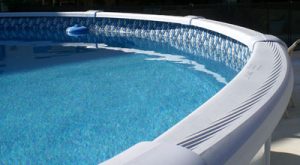
Orlando Above Ground Pool Installations

Recent Posts

Different Types of Ladders and Steps for Above Ground Pools in Orlando


With above-ground swimming pools, you get a few choices regarding how you can get in and out of them. These are called ladders or steps.

In Orlando, all types of steps and ladders for above-ground pools are popular.

LADDERS VERSUS STEPS FOR ABOVE-GROUND POOLS

When buying an AG pool as a package, it will always come with something that can get swimmers up and over the pool’s wall both going in the water and exiting it. In most cases, this will be a basic A-frame ladder.

A ladder for an above-ground pool is simply rungs that you step on that go up to the top of the pool’s wall, a small platform at the top, and then rungs that you step on to lower into the water inside the pool.

“Steps” for above-ground pools are a bit of an upgrade and usually have to be added to the pool package with an extra cost.

Steps for AG pools will be rungs going up to the top of the pool’s wall and are connected with a backing. The platforms of each rung (that you step on) are usually both longer and wider than just a ladder. After a small platform at the top of the pool’s wall, those same longer and wider platformed rungs go down and into the water of the pool.

As a general rule, pool steps are bigger, safer, and cost more than pool ladders.

THE DIFFERENT TYPES OF LADDERS AND STEPS FOR ABOVE-GROUND POOLS

A A-frame ladder

This is the standard and most common type of pool ladder. It simply has rungs outside of the pool from the ground going up, a small platform that sits on the pool’s top rail, and then rungs going down into the water all the way to the bottom.

This ladder makes an “A” shape and that’s why it’s called an a-frame ladder.

B In-pool only or deck ladder

This ladder only has a small platform that sits on a top rail of the pool, and then has rungs that go into the water inside to the pool’s bottom.

With this type of ladder, you need to have a deck outside of the pool for top entry.

C Pool steps

Just like a staircase, actual steps (not just thin rungs) will go up from the ground outside of the pool to a top platform that sits over the pool’s top rail, then steps will continue down into the water all the way to the floor of the pool.

Full pool steps going from ground to pool bottom are the biggest and usually the most expensive option for getting into an above-ground pool.

D Ladder/steps combo

With this, you have a ladder on the outside of the pool with rungs going from the ground up to a small platform at the top. And steps continue into the water going to the pool’s bottom.

E In-pool steps only

Just like the in-pool ladder, this only has steps going into the water of the pool and nothing outside.

This type of pool steps require a deck attached to the outside of the pool for top entry.

F In-pool wedding cake steps

Only inside of the pool, it starts with the first step being small, then each step gets longer with more area as they go down into the pool. The longer steps wrap around making half-circle shapes getting bigger as they get deeper.

With small to bigger steps going from top to bottom, these pool steps look like a multi-layered wedding cake.

THINGS TO KNOW ABOUT STEPS AND LADDERS FOR ABOVE-GROUND POOLS

1 All ladders for above-ground pools are safety ladders

Any ladders (or steps) for above-ground pools with an outside portion (not in-pool only) MUST be safety ladders.

This means that the rungs are made to lock upward or shielded in some way so they cannot be climbed when secured.

For most of the less expensive ladders, the rungs are designed to be lifted upward and locked in place so kids (and dogs) cannot climb up them.

Safety ladders are not as important closer to downtown Orlando as most homes will have fenced-in backyards. When you go further out and into the Central Florida country, there are fewer yards that are fenced.

2 Steps and ladders have weight ratings

America is known for having some pretty big people. And Orlando is no exception to that. Most pool ladders/steps can handle a fair amount of user weight, but bigger people may need more support.

Standard a-frame ladders for above-ground pools will have a weight limit or rating of 300lbs or 350lbs and some upgraded ladders will go to over 400 pounds.

Steps typically support more weight than ladders. Most steps support from 400 lbs all the way to 600 lbs depending on the model and cost.

NOTE: Some need the maximum weight and size for getting into the pool. For this, I recommend building a permanent outside step and deck structure from wood or concrete.
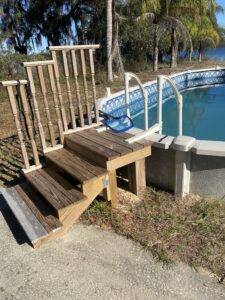
Wood steps built for a semi-inground above ground pool

3 Steps and ladders have to be assembled

With the exception of some wedding cake-type steps (which are all one piece), both steps and ladders come in parts and have to be assembled.

NOTE: Professional pool installers will NOT assemble or install pool ladders. This is where many slip and get injured, so no one will take that responsibility.

4 You can put the ladder/steps anywhere around the pool that you want.

No one area of an above-ground pool is better than the other for where you put the ladder. So. Set the ladder/steps in a good spot for traffic from the house or deck to the pool.

5 Most steps and ladders have to be bolted to the top of the pool or deck

For nice stability, it’s usually a good idea to bolt the top platform of the ladder to a pool top rail. And if you have a deck, screwing the in-pool ladder supports to the deck is needed.

TIP: Make very sure that you bolt or screw the ladder/steps down using only stainless steel bolts/screws. Everything else may rust badly and not be able to come apart when it’s time to change the liner.

6 Install the ladder/steps when the pool is at least half full of water

Most ladders go in when the pool is being installed. You want to wait for the pool to have enough water in it so the liner is set well and has a lot of water weight at the bottom BEFORE placing the inside ladder/steps on the pool’s floor.

7 Ladders/steps have to be weighted down

The part of the ladder or steps sitting in the water of the pool will want to float. This is not good as you want the steps/ladder to be very stable and not move.

People use all kinds of things to weigh down their steps. I am a fan of using pieces of sand-filled and capped PVC pipes and attaching them with zip ties.

8 Some steps/ladders will have handrails. Some will not.

Take an inventory of the elderly or immobile pool users that you may have with your pool. You may want to get a ladder or steps with one or two handrails to help people get in and out of the pool.

Tip: For extremely immobile pool users, I recommend having a wood ladder and deck built for accessing the pool. With this, you can make the entry as big, wide, and stable as is needed.

It will cost more, but someone who is not comfortable with getting into a pool probably won’t bother getting in, even if they really need to.
Above Ground Pools and Decks in Orlando


In Orlando, there are a lot of above-ground swimming pools with decks. It’s just natural to have someplace to hang out near the water’s edge.

With such a hot climate, Central Florida is the second-largest pool market in the US. And along with swimming pools come decks.

THINGS TO CONSIDER WHEN HAVING A DECK WITH AN ABOVE-GROUND POOL IN ORLANDO

If you are either looking at an existing above-ground pool with a deck OR planning on building a deck with your pool, consider the following.

1 What height do you want the deck to be

Since above-ground pools are mostly above the ground (Duh), you want to decide what height that you want the deck to be.

Decks built high next to the pool

In nature, water is almost always at our feet. This is why most will have the deck built high against their above-ground pool. Being able to see the water unobstructed while sitting on your pool deck or grilling, etc. feels nice and natural.

Being able to watch swimmer’s activity along with keeping a good eye on small children is another top reason to build the deck up high.

The biggest negative to building a deck high against an AG pool is a loss of privacy. Activity on high decks can easily be seen by neighbors adjacent to the yard.

Note: When building a deck high against an above-ground pool, keep in mind that the pool’s liner will have to be changed in the future. Liner changeouts require the top of the pool to come apart, so make sure the deck doesn’t get in the way of that.

I recommend the deck built at the level right below the pool’s top rails. With this height, the deck boards end under the top rails (so they don’t have to line up perfectly) and you can take the top of the pool apart easier for liner changes.

Decks built at ground level

Many decks in Orlando are built at ground level next to an above-ground pool. The advantages here are better privacy, more options on what it is made of, and safety.

Ground-level decks can be built from wood, composite, pavers, or poured concrete, while higher decks can only be made with wood or wood composite.

2 How big do you want the deck?

In general, most want a deck to be as big as they can fit and afford. With above-ground pools though, some are thinking that the deck will be temporary (along with the pool), so they want something smaller.

Questions to answer to help determine how big of a deck you want.

A How many people will be on the deck at one time?

Two people need a smaller deck than four do. Decide how many kids, adults, and animals will be occupying the deck at one time.

B What will be permanently going on the deck?

If you are thinking of two lounge chairs, a small table, a couple of regular chairs, a grill, and a pool toy storage box, know that you are going to need a certain-sized deck to hold all of that.

C What will you be using the deck for?

Some just want a deck only big enough to climb up to and access the pool with. Some will want to have parties on their pool deck. Others may want a deck to lay out in the sun with only.

Determining what the deck will be used for will help you decide how big it has to be.

3 What is your deck budget?

Having a pool deck is nice. It’s also expensive to build.

In many cases in Orlando, people are deciding to get an above-ground pool instead of an inground because they have a smaller pool budget.

The cost of an above-ground swimming pool package and its installation is one thing, but when you add the cost of a nice deck along with it, you can get to a big number in a hurry.

To be financially responsible, it’s best to have a cost limit for your pool deck beforehand. You may have 5k into your pool and install, and then discover that the deck you want is two or three times what the pool cost.

Knowing how much you have to spend on the deck beforehand will help you not get depressed or spend more than you wanted to for the overall pool project.

4 What is the deck made of?

Most above-ground pool decks here in Orlando are made of pressure-treated wood. This is mainly due to cost and the fact that most AG pool decks in Orange County, Florida are built high against the pool.

Using a wood composite material is a nicer but more expensive option for high AG decks. And when I say “more expensive”, I mean a lot more expensive than PT wood.

For lower decks, most go with pavers as they look better and last a long time. Poured concrete decks are very nice too. And I’ve also seen a lot of ground-level decks built with composite or pressure-treated wood as well.

In Orlando, there aren’t many contractors that will build wood decks, but they are out there. Most can find a deck guy in the Orlando, Spacecoast, or Lakeland Graigslist. Some also will do a local Google search to find a deck guy.

While the Orlando area has its fair share of concrete companies to pour decks, it has an. Unusually high number of paver installers. This is mainly because of the large Brazilian population in Orlando.

So, Finding a paver installation company will be the easiest to find in O-Town.

5 The safety of the deck

While some just build a platform deck high next to their AG pool, others will consider the safety of it by building a railing around it.

Railing or fencing with a deck is nice and can make the overall project look a lot better, but it will cost you. Also, building a railing that will prevent small children from going through will cost more as it requires more materials to build.

And with safety in mind, most will attach a gate to the steps of their high deck for above-ground pools. This will be lockable and prevent kids and animals from entering the deck.

6 The look of your (high) deck

Decks built high against above-ground pools can look ugly to some. Consider this when having one built. Some will choose to add lattice work to the outside of the deck.

And having more attractive railing added to the deck can make it look much better.

Consider adding landscaping around the deck too so it looks better in the yard.

7 Deck maintenance

The direct Orlando sun is really hard on everything. Wood decks are no exception to this. Keeping your wood deck clean, dry, and possibly regularly stained will help it last a much longer time.

USE Quality deck screws – When building a wood deck, few are thinking that the boards may have to come off one day (for one reason or another).

Sometimes with an above-ground pool deck, some of the boards may have to come off. And if they do, you better have used good deck screws when it was built. Sub-standard deck screws will rust or get brittle and break off when trying to unscrew.

Decks attached with quality screws will come apart easily, so spend the extra few bucks for good screws. I recommend spending even more for stainless steel decking screws.

Installing an Oval Above Ground Pool in Orlando


Oval above-ground swimming pools aren’t easy to install. And in Orlando, there aren’t many installers with a lot of experience with them.

Although somewhat popular with wanting one in the greater Orlando area, oval-shaped AG pools are much fewer in number than round pools.

DURING THE SUMMER IN ORLANDO, GETTING AN INSTALLER FOR AN OVAL MAY BE TOUGH

Above-ground pool installers get very busy during the hot months in Orlando, which is typically about 8 months out of the year. And with round-shaped pools being easier to assemble, installers will choose to do those over ovals when busy.

DIY INSTALLATION OF AN OVAL ABOVE-GROUND POOL IN ORLANDO WON’T BE EASY

In many cases, pool owners choose to self-install their metal-walled oval pool. This is either to save the higher cost of having one installed OR they can’t find anyone in the Central Florida area to do it.

This will be a difficult DIY project for anyone regardless of construction experience. Especially if attempted during the hot summer.

THINGS TO KNOW ABOUT INSTALLING AN OVAL ABOVE-GROUND POOL IN ORLANDO

1 Engineering is not great

With now 37 years of pool installation experience, I can tell you that oval pools are not at all designed or engineered well.

It’s important to know this if you are self-installing one OR paying someone to install one. No part of an oval will go together perfectly and often they won’t look perfect when done regardless of who installs it.

2 Ovals have buttresses

You may buy an oval model that says “buttress-free” or “yardmore” in the description. But if the shape of the pool has straight sides, then it must have buttresses.

And buttresses take more space in the yard and have to be assembled.

3 The buttress structure goes in the ground some

If DIYing, don’t spend a lot of time smoothing out your earth before setting your bottom track. The buttresses usually have to be recessed some in the ground, so all of that work you do leveling and smoothing out the area will be a waste of a step.

4 Ovals can take more than a day to have installed

During the hot summer of Orlando, everything done outside (especially in direct sunlight) will take more time to do.

Although an experienced installation crew can usually get an oval done in a day, they may run into an issue and decide to finish it up the next day.

Do-it-yourselfers can expect to spend a few days installing an oval pool. Especially in the summer.

5 Semi-inground ovals need a bigger hole

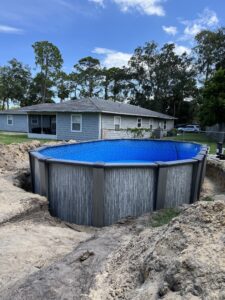
15x26 Oval above ground pool semi-inground
This oval’s buttresses stuck out about 18″, so it needed a wider hole

Ovals have buttresses that stick out some on the straight sides of the pool. So, when installing an oval in a hole, extra space is needed to set and level these buttresses.

Finding out how far your model of oval buttresses stick out beyond the pool’s wall will allow you to dig the correct-sized hole for installation.

Depending on the model, buttresses can protrude out from the pool wall eight inches to three feet, three inches. This is a wide variation so it’s best to know before digging the hole.

NOTE: Most upgraded oval models for Wilbar pools need one foot, seven inches beyond the wall of the pool.

6 Ovals are easier to keep the wall up during the installation

One of the trickiest parts of installing an above-ground pool is rolling out and erecting the wall of the pool. Since oval-shaped pools have buttresses, they are already set in place and assembled together when the wall goes up.

So, when rolling out the wall in place, it can be secured well to the buttresses which will help it from falling down before you get it bolted together and completed.

7 Some will use extra sand

Since Orlando and Central Florida have mostly sand-based earth, additional sand is usually not recommended or required for an above-ground pool installation.

Since ovals have buttresses that are buried some in the ground, some will elect to have some extra sand to spread on top of the buttress structure and its water plates.

8 I recommend a liner guard with an oval-shaped pool

Since some metal parts lay directly underneath the floor of an oval pool, I recommend putting down a liner guard just in case something happens later with the pool’s floor.

A liner guard/pad isn’t much really, but it is a piece of cloth that can protect the liner from any of those metal parts if the earth between them and the liner moves or wash away.

Installing an Overlap-Type Liner for an Above Ground Pool in Orlando


Overlap-type liners are considered the “old type” of liner, but some still use them for their above-ground pools in Orlando.

With being an above-ground pool installer for 38 years, I remember when there were only overlap type liners for above grounds. Then the uni-bead and J-hook type came out and all but completely replaced the inferior overlap type.

Overlap liners would’ve drifted completely away (for standard above-ground pools) like the CD player, but Doughboy’s slow to grow with the times kept the overlap in play. They too eventually went almost entirely with unibead/j-hook types.

Overlaps have made a bit of a comeback though. This is because online retailers like Linerworld started selling a lot of liners made in China. And in the early years of China making liners for above-ground pools, they only made overlap-types

I’m not a fan of overlap-type liners to begin with, but with the market getting a bunch of these cheaply-made Chinese overlap-type liners that would only last a year or two, I was especially annoyed.

Chinese-made liners have gotten a little better over the years, but I still never recommend getting one as they don’t last nearly as long as one made in North America.

5 THINGS TO KNOW ABOUT INSTALLING AN OVERLAP-TYPE LINER IN ORLANDO

1 Overlap liners need coping strips

This type of liner is set on the inside of the pool and then the excess of liner is pulled over the wall and hangs over the outside. This is why it’s called an “overlap” liner.

The part of the liner that hangs over the top of the wall must be secured by long plastic strips called “coping strips”.

Coping strips can dry out and get brittle. When that happens, you will need new strips when replacing an overlap liner.

NOTE: You will not find coping strips for sale in Orlando. You will have to order them online.

2 Overlap liners can be used for 48”,52”, and 54” height walls

A standard overlap liner made in the US or Canada will have 60 inches (or five feet) of material that makes up the sides of the liner. (Chinese-made overlaps can have less)

This means that you can use the same liner for all above-ground pool wall heights.

3 If the liner has a pattern, you should make it consistent at the top

Since an overlap liner is adjustable (how much excess liner can go over the wall), if it has a pattern, then the liner should go over the wall the same amount all the way around the pool.

By doing this, the pattern in the liner will be consistent with the waterline when you fill the pool.

NOTE: If the pool was poorly installed and severely out of shape (exp. egg-shaped instead of round), then you may not be able to have a consistent liner pattern at the waterline.

4 You will see the liner on the outside wall of the pool

Since overlap-type liners are designed for its excess wall material to hang over the wall, you will see it on the outside hanging behind the uprights.

Depending on the model of the pool, you can roll the excess liner up and hide it under the top rails. Not all models will have room for that though.

5 Overlap-type liners are not ideal for semi-inground pools

If your pool is partially in the ground, then overlap liners are not recommended.

WHY? Because overlap liners require you to have more space between the top of the wall and the pool’s uprights. And when a pool is buried some, the uprights push tightly against the wall (because they are buried in the ground) and cannot move outward.

Also, since there is always a potential for a cave-in (outside earth pushing the wall inward) during a liner changeout of a semi-inground pool, you want to move the wall as little as possible and not disturb its position.

How Long Does an Above Ground Pool Liner Last in Orlando


The long and hot Orlando summer can be brutal on above-ground pool liners. And here, they may not last as long as areas in the north.

Over a span of 37 years, I have seen, installed, and changed thousands of above-ground swimming pool liners in Central Florida. Here are some of my long-term observations.

Above-ground pool liners in Orlando last on average 3-5 years for a standard gauge and 5-8 years for a heavy gauge. This is providing the liner was made in the US or Canada AND was properly installed.

4 MAIN FACTORS THAT DETERMINE HOW LONG AN AG POOL LINER WILL LAST IN ORLANDO

1 Quality of the liner

Installing a heavy gauge, fully printed, liner made in the USA or Canada is your best bet for a long-lasting liner.

2 Proper adding of chemicals

Adding granular chlorine directly to the pool without first diluting it will bleach out the liner and take life from it. Granulate chlorine sitting on the bottom of the pool makes the liner in contact with brittle and eventually prone to cracking (leaking).

If you can, use liquid chlorine instead of granular. Liquid chlorine will disperse quickly in the pool and not sit at the bottom and bleach out the liner.

NOTE: There is an above-ground pool retailer in Orlando that does not recommend using liquid chlorine in above-ground vinyl pools. For the life of me, I don’t understand why. My only explanation is that they are giving out bad advice because they just don’t know any better.

3 The amount of direct hot sunlight

Orlando gets a lot of direct sunlight. And although I have seen many liners that get a lot of direct sun last many years, as a general rule, it takes some life from the liner.

I’m not a big fan of covering above-ground pools. Only because it is such a pain to put them on and take them off. However I have noticed pools that are covered have longer-lasting liners.

4 How well they were installed

Vinyl liners made for above-ground pools can take a decent amount of abuse. They can stretch and be pulled out of shape more than you think and still hold water well.

I have noticed though that liners not installed well are more prone to leaks and don’t last as long as those installed well.

LINERS MAY LAST LONGER WITH LINER GUARDS, BUT IT DEPENDS

Liner guards(pads) are very popular for above-ground pools. And they do have their advantages, but allowing the liner to last longer isn’t necessarily one of them.

If the earth bottom of a pool has a lot of debris, has an oily base, or has a lot of nutgrass in it, then a liner pad can prolong the life of the liner.

This is only because the liner guard will prevent some leaks, which will help add time before the liner needs replacing.

THE LINER I RECOMMEND

I don’t sell liners and am not here to tell you where to buy one. So, this isn’t a sales directive. Just an observation as to which type of liner will last longer.

If you can, get a heavy gauge (usually described as 25), fully printed, unibead/J-hook type, liner ABSOLUTELY MADE IN THE US OR CANADA.

The above liner should last you 5-8 years in Orlando on average.

What is the Best Type of Filter for an Above Ground Pool in Orlando


Orlando has very long, hot, and humid swim seasons. This is the main reason why a cartridge-type filter is best here for an above-ground pool.

When I started my pool maintenance business in the late 1980s, most of the Inground swimming pools here in Orlando had sand-type filters. And almost all of the above-ground pools had them.

Over the sixteen-year span of my service business, cartridge-type filters all but replaced the sand-type in ingrounds AND more than half of above-ground pools came with cartridge filters.

THERE ARE THREE TYPES OF FILTERS FOR ABOVE-GROUND POOLS

1 Sand-type

This filter uses sand to clean pool water. Water is pumped through a tank of sand and particles get trapped in the sand with the cleaner water making its way back to the pool.

When the sand has trapped a lot of debris over a few weeks, it is cleaned by reversing the flow of water through the sand and sending the trapped debris out into the yard. This is called “backwashing”.

2 Cartridge-type

This kind of filter uses a pleated element made of a synthetic “denim-like” material. As water is pumped into the filter tank, it has to flow through this element to make it back to the pool. The element traps debris only allowing the water to get through.

When the element has trapped a lot of debris, it is pulled out of the tank and manually sprayed down with a pressure nozzle on a water hose cleaning off the trapped debris from the outside of the element.

3 DE-type

DE filters use grids framed in plastic and covered with the same synthetic type of material used with a cartridge filter element. Only it’s not pleated.

Those grids sit positioned in a tank and are evenly coated with DE (diatomaceous earth) powder. As pool water pumps through the tank, it has to pass through these DE-coated grids. The powder traps debris.

When the DE powder is full of debris, The flow of water in the tank is reversed and the now dirty DE powder comes off of the grids and is pumped out into the yard.

NOTE: The grids in a DE-type filter need to be taken out of the tank body and manually sprayed down with a pressure nozzle on a water hose at least once every 18 months.

WHY SAND-TYPE FILTERS AREN’T IDEAL FOR ABOVE-GROUND POOLS IN ORLANDO

The Central Florida climate is considered humid subtropical. You can look up what that means exactly but for your swimming pool, it means a long and brutally hot summer of high algae growth and chemistry affecting rains.

A sand filter does not trap as small of particles from the water as the other two filter types do, so it’s not as efficient.

Plus, a sand filter is a closed-type filter, which means it is not designed to open up. So, you are not able to look inside and see the status of the condition of the sand. Filter sand can get caked up and stop allowing water to flow through it.

Because a sand filter is closed, half of the sand inside may be caked up and not working and you will never know it. And with it being closed, you can never tell how well the sand got cleaned during backwashing.

They may be OK for a pool in the north where the extreme summer season is a couple of months long and 75% humidity is considered “very humid”.

The summer in Orlando is no joke. And the hotter it is and more humid, the more things like to grow in pool water. This is another big reason I’m not a fan of sand filters in Florida.

With our brutal summer climate and extreme afternoon thunderstorms (not to mention tropical storms), the likelihood of a pool turning green occasionally is much greater.

With their higher micron rating and unknown working status, it takes a lot longer to bring a swimming pool back to clean and clear with a sand-type filter in comparison to a cartridge or DE type.

WHY I AM NOT A FAN OF A DE-TYPE FILTER FOR ABOVE GROUND SWIMMING POOLS

While D.E. filters are the best kind of pool filter in terms of their micron rating (they trap the smallest particles from the water), there are three things that I don’t like about them.

1 They are expensive to buy

DE-type filters are more expensive (comparing same size/quality) than both cartridge and sand filters.

This may be okay for those affording a one hundred plus thousand dollar in-ground concrete pool, but most getting an above-ground pool are on a much smaller, tighter budget.

So, the extra $200-$300 for a DE filter is a much greater percentage increase with above-ground pools.

2 They break more

With my now 38 years of working with swimming pools, I can tell you that DE-type filters break more than the other two. They have grids or fingers inside of them that get holes or break, a manifold that can crack, and multi-port valves or pump handles that can leak or fail over time.

Again, if you have a big money in-ground pool with bells and whistles, you can expect and have a budget for repairs. A filter breaking may not be as impacting if you have a pool service guy who can stay on top of fixing things.

Most above-ground pools are maintained by the pool owner. And in most cases in Orlando, you cannot get a pool repair guy to come out and work on above grounds. So, having a filter that breaks can suck a lot more with an AG pool.

3 DE powder is very toxic

This isn’t something you will hear much. Diatomaceous earth, although harmless looking, is very toxic to your lungs.

During my early years of servicing pools here in Orlando, I didn’t know about DE powder. I would work with it as if it were as harmless as Goldmetal flour.

Then I got some in my eye one day, and it messed up my eye pretty good. I wondered how this harmless white powder could do that, so I researched DE powder.

Turns out that DE powder is such a good filter media because it adheres to and absorbs things well. Under a microscope, it looks like billions of tiny fishhooks. So yeah, whatever DE powder you breathe into your lungs is going to be staying there for a long while.

I want to mention one very positive thing about DE filters. There is no better filter for getting a green pool back to clear again. DE filters combined with someone experienced with turning a green pool around will get the job done days faster than pools with sand filters.

3 REASONS WHY I THINK A CARTRIDGE-TYPE FILTER IS BEST FOR ABOVE-GROUND POOLS IN ORLANDO

1 They work well

Over the last 30 years or so, the elements for cartridge-type filters have gotten better in terms of their micro rating. Cartridge filters are now pretty close to as good as DE filters at removing smaller particles from the pool water.

2 They are a simpler design and have fewer parts

Our current civilization is notorious for complicating just about everything supposedly for the better. Yeah sorry. I don’t buy it.

Cartridge filters are simple. This means they don’t have as many parts that can break or a complex design that can fail.

And they work well, so no need to try to over-improve them. (Ever tried to fix a Kuerig? What a complex joke.)

Simple means cheaper to buy and breaks less, which is great. Especially for above-ground pool owners.

3 They are an “open” system

When you clean a cartridge filter, you have to open up the tank and pull out the element, This allows you to see exactly what is going on inside. If something is clogged or broken or looks bad, you can see it.

With sand and DE-type filters, it’s a guessing game as to how well it’s filtering water inside. They are designed to either never be opened (sand-type) or opened every year and a half (DE-type).

HAVING VALVES FOR YOUR ABOVE-GROUND POOL WILL MAKE IT EASIER

For an above-ground pool, the pump and filter sit below the level of the pool water. This means that any time you have to open the pump basket, filter, chlorinator, etc., you will get a backflow of water coming from the pool.

Plumbing in two valves (1 each for the skimmer and return line) will allow you to turn the water off coming from the pool, which will make it easier when cleaning the cartridge filter.