Orlando Above Ground Pool Installations

Recent Posts

There is Rust on My Above Ground Pool in Orlando


With traditional above-ground swimming pools in Orlando, rust can be one of the biggest concerns. Some rust is really no big deal while other rust means the end of the pool.

When is rust a concern? When is it no big deal? Hopefully, this article will help answer some questions.

METAL-WALLED ABOVE-GROUND POOLS ARE MADE OF STEEL, ALUMINUM, OR RESIN PARTS

Also called “hard-sided” AG pools come in all different variations of what parts are made of what. An above-ground pool has a wall, frame, and vinyl liner.

99 percent of the time, the wall of the pool is made of either steel or aluminum. Both will corrode (Steel makes a rust color, while aluminum pits away in small white circles)

The frame of the pool can be made of either steel, aluminum, resin, and usually a combination of a couple of those.

Only parts made of steel or aluminum will corrode.

PARTS OF AN ABOVE-GROUND POOL THAT CAN RUST (CORRODE)

1 The outside of the wall under the skimmer or return fitting

This is one of the most concerning areas to have rust. Rust in this area usually means that the skimmer box or the return fitting is leaking and has been for a while. This is not good.

Rust in this area should be looked at closely and addressed immediately.

Some surface rust is not ideal, but OK. It’s when the rust gets deeper into the metal wall that there will be a major issue.

The wall of the pool holds all the water, so if the rust starts to weaken the wall’s ability to hold the water, then it will burst and the pool will need replacing.

2 The outside of the wall at the bottom

Sometimes the pool’s wall will rust at the bottom. This can be due to ground moisture, what is sitting next to the pool (at ground level), foliage growing next to the pool, a weed whacker removing the coating, etc.

Rust at the bottom of the wall is concerning if it is starting to rust deep into the wall. Sticking a screwdriver into the rust area will help tell you how deep it is.

3 Rust in the outside middle of the wall

Rust somewhere randomly in the middle of the wall usually means something hit the pool causing it to scratch or dent and began the rust process. This can be from a rock thrown from a lawnmower, kids throwing things, a neighbor shooting his gun or bow(welcome to Florida), etc.

It’s usually not an issue, but again, using something to poke at the rusted area will tell you if it’s rusting into the wall.

4 Rust on the top rails
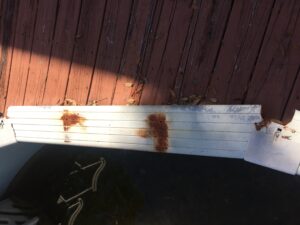
rust on top rail of above ground pool in Orlando

Rusty top rails usually aren’t any cause for concern unless it’s severe. If it’s so rusty that there are jagged, sharp areas, then that can be dangerous to swimmers.

Most of the time though, rust on top rails just looks bad and people can live with that.

5 Rusty upright/s (vertical supports)

Some will get very concerned when they discover that one or two of their pool’s uprights are rusting through. This will not look good, but in most cases, the pool will be fine even if a couple of uprights are rusted completely in half.

They have just some structural value for the pool’s frame, but not much for the wall(which is what holds the water), so don’t be alarmed in that regard.

6 Rusty parts under the top rails

Under the top rails of an AG pool, there will be connector plates and top stabilizer bars. Regardless of what the top rails are made of, what’s under them can be made of steel or aluminum.

Sometimes a pool owner will notice some small pieces of rust in the pool and wonder where it’s coming from. Usually, the rust is flaking off of either the top connectors OR the stabilizer bars from under the top rails.

Taking a peek under the pool’s top rails from the outside of the pool will show if anything is rusting.

Rusty top connector plates and stabilizer bars can be annoying if flaking off into the pool water, but they don’t need to be addressed right away.

If these parts are becoming very rusty though, then they may have to be replaced when it’s time to change the liner in the pool as they all have to come off.

7 Surface rust at the inside of the pool’s wall

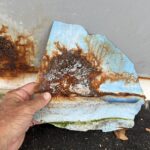
Surface rust inside of an above ground pool in Orlando

Usually, rust can only be identified inside of the wall when the liner is removed, which is usually during a liner changeout.

With this, some surface rust is ok and won’t hurt anything. If there is a lot of surface rust though, wall foam is recommended before installing the new liner.

This is a thin layer of foam glued onto the wall which will prevent the rust from touching the new liner anywhere.

8 Deep rust at the inside of the pool’s wall
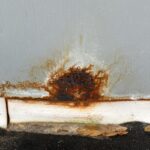
Again, usually discovered during a liner changeout, deep rust that is penetrating through the wall is cause for concern. Use a screwdriver or utility knife and poke the rusted areas to assess how deep the rust is or if it has rusted completely through the wall.

Rust on the walls that is penetrating deep into the metal is a major issue. One that is usually the cause for a total pool replacement.

WHAT CAUSES RUST ON ABOVE-GROUND POOLS?

When mixing metal with moisture, you’re going to have corrosion. So, swimming pools with metal parts that are outside have a high likelihood of corroding.

Not all above-ground pool rust though. In my now 38 years of working with them, I have seen many pools that are 10, 15, and even 20 years old with not a piece of rust. Most will rust some though with little issue.

Here in Orlando and Central Florida, we get morning dew. Dew makes everything outside a little wet in the morning. Then when that Florida sun comes up, it heats and dries everything back out. This can happen 200 days a year or more in Central Florida.

Dew isn’t an issue with above-ground pools because everything dries completely in a couple of hours. So, it’s when moisture stays on metal pool parts for extended periods of time that will cause corrosion or rust. Like if the pool has a leak for example.

A small leak in your above-ground pool may be no be deal to you (especially during the Orlando summer when it rains every day), but allowing it to continue may be keeping the metal wall wet in an area for too long.

Prolonged exposure to wetness can eventually cause the protective coatings of metal pool parts to break down or lift which exposes the metal to moisture. Then rust begins.

TREATING RUSTY PARTS OF AN ABOVE-GROUND POOL

When some have rust on their pool’s top rails, they will take them off, sand them down, and then paint them with some form of anti-rust coating (like Rustoleum).

This usually will make the top rails look better for a while, but eventually, the rust comes back. Usually, rust comes back sooner than later for all parts that pool owners try to protect. Most will feel it wasn’t worth all that sanding and painting as it didn’t buy them much time.

Some will go through the big job of sanding down all the surface rust on the inside wall of their AG pool, Then they coat it with different things. Most just use Rustoleum paint and others will spend a lot on a fancier anti-corrosion chemical, then paint.

With the inside of pool walls, treating the rusted walls do rarely any good at all (except give good exercise to those who sanded them down). The corrosion almost always continues right after a new liner goes in and the pool is filled and back in use.

So, for rusted parts of an above-ground pool, I recommend either living with them (if they aren’t too bad) or seeing if you can find replacement parts and replace them.

NOTE: Sometimes you can replace metal top connectors and stabilizer bars with resin-made ones. Will-bar made pools do offer this on a couple of models.

If your pool wall (on the inside) has only surface rust, then I recommend buying and using wall foam when the time comes to change the liner. This will protect the new liner from being damaged by the surface rust

And if your pool’s wall is rusted completely through, you may be able to repair it with a partial wall replacement, but that is expensive, and hard to find someone who can do it correctly. More than likely, Replacing the entire pool is the way to go if the area is rusted through low and more than a couple of inches wide.

WHEN A RUSTED ABOVE-GROUND POOL NEEDS TO BE REPLACED

There are four main reasons that you may want to replace your AG pool due to rust/corrosion.

A The wall is rusted through

With an above-ground pool, it’s the wall that holds all of that water in place. The entire pool frame can be rusted, broken, or even removed, the pool will stay up.

A little rust hole towards the bottom of the wall though, and the pool can split open sending thousands of gallons of water into the yard and killing the pool.

Rusted-through pool walls should be addressed quickly as it can be a dangerous situation. In many cases, replacing the entire pool is the best answer.

B Rusting top rails are a danger to swimmers

The top rails of an above-ground pool are where swimmers will grab onto while using the pool or use them to get in or out of the water.

Rusted and jagged top rails can pose a threat to swimmers by cutting them when they grab on. Not cool.

When you can’t find replacement top rails (for your model) or it’s too expensive to do so, then replacing the pool is the best option.

C Pieces of rust are falling into the water

When top connectors, stabilizer bars, or even top rails are severely rusted, small pieces of rust will come off and fall into the pool. This can be a pain to constantly clean up. Also, sharp rusty pieces can cause holes in aged liners or can poke into swimmer’s feet.
If replacement parts cannot be found or it’s too expensive to replace them all, then the best option often is replacing the entire pool.

D The pool looks ugly

Some just get tired of looking at the rust on their pool and elect to replace it. In many cases, it needs replacing anyway.
Replacing an Above Ground Pool in Orlando


Even though most who get an above-ground pool are thinking that they will only have it for a few years, many decide to keep them beyond the pool’s life AND wind up replacing it with a new one.

Every year in Orlando, I remove existing above-ground pools and replace them with brand-new ones. Often, they are replaced in the same place with the same size and shape.

WHEN IS IT TIME TO REPLACE YOUR ABOVE-GROUND POOL

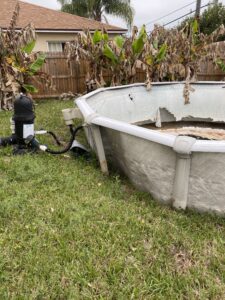
Traditional above-ground swimming pools don’t last forever. Most will need replacing because the wall of the pool has become too rusty and is either in danger of blowing out (all of the pool’s water into the yard) or has already blown out.

For some others, the top rails have become rusty (if made of steel) or are cracking, discolored, sagging, or breaking (if made of resin). This has made the pool look bad and/or unpleasant to swim in.

In Orlando and surrounding towns, expect an above-ground pool to last between 10 and 20 years due to Central Florida’s harsh weather.

Other less common reasons to replace an AG pool are as follows:

A Big tree branches fell on them

B Tornadoes ( I replaced one that got sucked up into the sky in Deland during a tornado)

C Very poorly installed (They don’t last long when extremely off-level or out of shape)

D Pet horses rubbing against them (happened in Geneva once)

E Cows falling into them (happened in the Manor in St Cloud)

F Cars driving into them (Replaced for this reason in Kissimmee )

G Can’t get frame parts for the model anymore

H Neighbors accidentally shooting holes in them ( I’ve replaced several for this reason. Welcome to Florida)

REPLACING AN ABOVE-GROUND POOL WITH AN EXISTING DECK

Wood deck for an 18' round above ground pool in Winter Park Florida

In Orlando, having a deck along with an AG pool is very common. Here are some things you should know about replacing the old pool next to your deck with a new one.

1 The new pool very rarely will go back in the exact spot

Even though you are getting the same size pool, chances are that you won’t be able to get the new pool’s uprights exactly where the old ones were.

So, if the existing pool’s deck was built around the pool’s uprights, the new pool won’t fit perfectly to each cutout in the deck.

This is because every pool and model has slightly different dimensions AND each upright has a slightly different distance between them. So, if your deck is perfect to the existing pool, it won’t be perfect to the new pool.

2 In almost all cases, the deck was built AFTER the pool was installed.

Why does this matter? Because if your existing pool is out of round slightly AND/OR is not level, then the deck was built for a pool that is out of round and/or out of level.

Sooo, when the new pool goes in and the installer (like me) does a good job, the new pool will be level and in the correct shape (usually round). Soooo, if the existing deck is NOT quite level or built for a correctly shaped pool, then it will look and be off (not perfect).

3 Above ground pools come in three different heights – 48”, 52”, and 54”

Now why does THIS matter? Many decks are built to a specific height in relation to the height of the existing pool. So, if your new pool is a different height than the old one, then it will either sit higher (usually) or lower next to the deck than the old one did.

It’s common for people to want their new pool to be at the same level (in relation to the deck) as the old one was. If this is you, then my advice is to make sure your new pool is the same height as the old one.

This can be an issue if you have an older pool that is 48” tall. Most AG pools now are 52” and 54” high, so it can be hard to find a nice 48” walled pool anymore.

For most cases, if the new pool has a taller wall, then install the pool at the same level as the old one and just have a higher-looking pool sitting next to the deck. Unless your existing deck is sitting over the top rails that is.

4 Some decking may have to be cut to fit the new pool

During my years of martial arts training, I learned the 3 rules of fighting someone with a knife – Rule 1 “You’re gonna get cut”, Rule 2 “You’re gonna get cut”, and Rule 3 “You’re gonna get cut”.

After 38 years of replacing above-ground pools next to decks, I have one thing to say to the deck – “You’re gonna get cut”.

Yep, many decks have to get cut a little to make the new pool fit as close as possible. Try to accept this fact early on and you’ll be happier.

5 If needed, this is a great time to repair or replace the decking

REPLACING AN ABOVE-GROUND POOL THAT IS SEMI-INGROUND

Semi-inground 18' round above ground pool in Sanford, fl  caved in

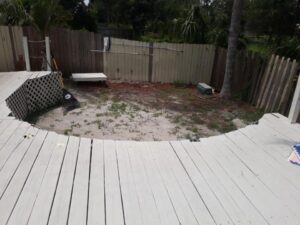
Here in Orlando, sinking an above-ground pool partially in the ground is very common. AG pools in the ground some will last just as long as those above the ground, but some will need replacing.

It’s a little harder to replace an above-ground pool when its semi in the ground. You have to get in and out of that hole a lot and that takes extra energy. The biggest thing you should know though is this:

Replacing a semi-inground pool requires you to dig the hole bigger all the way around by AT LEAST eight inches. (For many, a foot wider or more is required)

It’s common to not think about the extra space it takes to assemble an above-ground pool. I mean, you can’t put the pool together somewhere else and helicopter it into place from the sky. LOL

Shaving the existing hole 8-12 inches bigger all the way around can be a bit of a job with things like roots from landscaping, decorative stones or mulch in the way, and/or weed-blocking materials. It can really be a party dealing with all of that stuff.

The good news here is that most of greater Orlando is sand-based, so shaving the hole should be easier than if it was hard earth.

And the dirt dug out to make the hole bigger will be in piles around the pool area, which can make a bit of a mess.

REPLACING AN OVAL ABOVE-GROUND POOL

The biggest thing to know here is that ovals have structures along their straight sides called buttresses. Every size and model can have a different number of buttresses AND they can sit in different spots within the pool’s footprint.

So, if you’re replacing an oval in a tight spot, you may not have the room for where the new pool’s buttresses will be protruding from the pool’s wall along the straight sides.

This can be an issue too if you have an existing deck. I often have to move either a couple of 4×4 wood deck supports OR shift where the new pool is going because the new buttresses are running into the existing deck supports.

How Long Does an Above Ground Pool Last in Orlando


Above-ground swimming pools are more popular in Orlando than many think. Tens of thousands of Central Florida backyards have them (and some front yards too).

But how long does an above-ground pool last here in Orlando? How do they fair in this intense sunshine and long, brutal summers?

THE DIFFERENT TYPES OF ABOVE-GROUND POOLS

When I started installing above-ground pools, there was only one kind. Then Walmart started selling a pool with soft sides for way cheap. A while after that, AG pool manufacturers started making pools designed to go in the ground some of that were way expensive.

So, as I see it, there are three main types of above-ground pools

1 Soft-sided pools made by Intex, Bestway, Coleman, etc.

These are the cheapest pools that you can buy and most are bought through Walmart.

These pools usually come in just one big box, have poor equipment (pump, filter, ladder), and are easiest to install.

In Orlando, soft-sided pools last an average of one or two seasons (summers).

These pools are good for those with the least amount to spend for a pool OR if they just want to see if having a pool is good for them. Many start out with one of these and then graduate to a metal-walled pool later.

2 Metal-walled (hard-sided) pools

When someone says “above-ground pool”, this is usually what they mean. These pools come in several boxes, usually have decent equipment, and are harder to install.

In the Orlando area, metal-walled pools last an average of between 10 – 20 years.

Traditional metal-walled above-ground pools give you the best value for what you get as they provide a nice swimmer experience, can come with good equipment, and will last many years.

3 Above ground pools designed for semi-inground (partially in the ground)

About 25 years or so ago, it started to become common for people to buy an above-ground pool and sink it in the ground some. This was (and still is) a good, inexpensive alternative to having an inground pool.

Since above-ground pools are designed to go above the ground (duh), a drawback to sinking one in the ground is that it can cave in when you drain the water from it.

To answer this demand, AG pool makers (namely Wilbar) designed pools with walls that were sturdier (for being in the ground) and didn’t corrode to failure. These special walls were usually made of thicker, extruded aluminum and came in sections.

Semi-inground above-ground pool models will last for decades

The big negative to this type of above-ground pool is the price. They are usually two to three times the cost of a traditional metal-walled above-ground pool. And this is usually not worth the added life you will get out of it.

SEMI-INGROUND POOLS THAT ARE NOT ABOVE-GROUND POOLS

Lately, with the surge in concrete inground pool prices, a hybrid pool has become an option. This is a pool that can be completely out of the ground, in the ground some, and all the way in the ground.

These hybrid pools have paneled walls made of either resin or steel, are bolted together, and are supported by a concrete collar at the base.

I DO NOT CONSIDER THIS TYPE OF POOL AN ABOVE GROUND POOL

The Reasons?

1 Almost 100 percent of people who buy this type of swimming pool will put it in the ground some. In contrast, most above-ground pools will be installed above the ground.

2 This type of swimming pool has no real top rail. Something has to be added to the top of this pool to make it look complete. Actual above-ground pools don’t need anything beyond their frame and top rails.

3 This type of pool has very plain and unfinished walls. Above the ground, these walls look out of place and unfinished.

4 The cost of this pool is closer to an inground cost. This type of pool kit costs tens of thousands of dollars. Way too expensive to be considered an above-ground pool.

Repairing an Above Ground Pool in Orlando


It can be very hard to get an above-ground swimming pool repaired in Orlando. In truth, Orlando and the surrounding counties of Orange, Osceola, Lake, Polk, and Volusia have very few companies that work with above grounds.

Most needing above-ground pool repair will begin by calling their local retail pool supply store like Pinch-A-Penny or Leslie’s only to find that they only service inground pools.

Next, they try pool service companies close to them. With them, they get the same rejection to AG pools.

Those persistent (or desperate) enough eventually find one of the half dozen above-ground pool guys in Central Florida, like me. When they finally get ahold of someone like me, they are ready to get something done quickly.

At that point, the above-ground pool guy (me) has to break it to them that he either doesn’t do that kind of repair OR is way too busy with full pool installs.

MOST WANT TO GET THEIR POOL REPAIRED DURING THE HOT MONTHS

Even though there are thousands of above-ground pools in need of something, I, along with the maybe five other above-ground pool guys in Central Florida, sit dormant starting as early as September through February.

This is because most above-ground pool owners don’t care about fixing their pools until it gets hot outside. Then, when it hits 90 degrees outside sometime in the spring, the phone comes to life as hundreds decide that they want to do something with their pools.

To make matters much worse, this is the same time that people wanting to get a pool start looking to get one. And since I and the five other guys around Orlando make most of our living doing full installations, we get too busy to do any other type of pool job.

THE DIFFERENT TYPES OF REPAIRS PEOPLE WANT FOR ABOVE-GROUND POOLS IN ORLANDO

Thinking that you can call one person to take care of any or all your needs for your above-ground pool is common with people starting out. In reality, it’s going to be hard to find anyone to do most things with an above-ground pool.

A guy like me for example will only mainly install pools or put new liners in them. It isn’t worth it for me to do much more than that during the busy season (which is when 90 plus percent inquire about a repair.

To possibly help you find someone for your issue, here’s a list of issues that people look for someone to help them with.

1 To find a leak

This is a super common reason people need a pool guy. Almost every pool will eventually leak, and above-ground pools are no exception to this.

When I started my pool service company in the late 1980s, pool service guys did everything (including find leaks). In the early 90s, leak detection-only companies started popping up in and around Orlando.

Now, few (inground) pool service guys will look for a leak. Most now will refer you to a leak detection company.

This holds true for above-ground pools too, although AG pool owners rarely opt to pay the expensive cost of a leak detection company.

YOUR OPTIONS

A Learn how to and find the leak yourself

B Call a leak detection company

2 To repair a leak

When it comes to vinyl above-ground swimming pools, finding the leak is almost always the hard part. Patching a found leak in the vinyl somewhere is very easy.

Again though, you most likely won’t find anyone who will repair the leak. Now, if the leak is somewhere within the pool’s equipment (pump, filter, piping, etc.), then you have a slightly better chance of finding a pool guy to fix that.

More than likely though, you’ll be on your own fixing any leak in your AG pool.

YOUR OPTIONS

A Learn how to and fix the leak yourself

B If within the equipment and visible, possibly find a pool guy or store willing to do it.

C If in the liner somewhere and the liner is more than 4 years old, replace the entire liner

3 Pump not working

There is a big difference between inground pool pumps and above-ground pool pumps. This is why pool stores will repair inground pool pumps and/or replace their motors, but will NOT work on above-ground pool pumps.

The difference? Inground pool pumps cost more and are designed to eventually have their parts and motors replaced while above-ground pool pumps are designed to just be replaced when they fail.

YOUR OPTIONS

First, rule out any electrical supply issues that may be preventing your pump from working (like tripped breaker, faulty GFCI, bad wires, etc.). If it’s the pump, get it replaced.

A Find the exact match pump, buy from where you bought the pool originally or online somewhere, and replace yourself

B Find a pool guy or store that is willing to do it. Most who work on inground pumps won’t though.

4 Pool is green or black

For one reason or another, many will find themselves with a green or black pool and need someone to come out and bring it back to clean, clear, and healthy again. It will be extremely hard to find someone willing to do this with an above-ground pool.

During my sixteen years of owning a pool service company, I specialized in bringing green (and dark green) pools back to clear. BUT I would only work with ingrounds and not above-ground pools.

Unless you live way out in the country and have an independent pool service guy out there willing to service AG pools, you simply will not find a service guy to bring your green above-ground pool back to clear.

Above grounds are just too different and in most cases more difficult to bring back to clear. Also, above-ground pool owners aren’t as willing to spend what it takes to pay a pool guy to bring a pool back to clear and clean.

YOUR OPTIONS

A Get your pool back to looking good and healthy yourself by learning how to do it.

B Drain the pool, change the liner, and replace anything not working that made the pool go green to begin with.

5 Pool is off-level and/or out misshaped

In just about every case, an above-ground pool is off-level or out of shape and looking “wonky” from day one of the installation. Pools rarely move later, so if your problem is that the pool is off, it was probably that way from the beginning and you are now just noticing it.

I bring this up because some think that their pool is getting worse (more and more off-level) when it probably isn’t. NOTE: Soft-sided (Intex, Coleman, Bestway) type pools can gradually lose their level and come down. This article is not about soft-sided pools though.

Fixing an above-ground pool that is too off-level or out of round (egg-shaped) is a major repair. This usually involves taking out the existing liner and replacing it with a new one while moving the pool’s wall and adjusting the pool bottom.

99 times out of 100, this is not an easy fix and will be expensive. Often, it’s better to just live with the off-level pool until it’s time to change the liner a few years down the road.

YOUR OPTIONS

A Contact the guy who installed the pool and talk to him about fixing it. If he did a bad job, he should be willing to fix it for free. Should be, that is.

B Get it fixed by finding a good pool installer who can do it. Be prepared to drain the pool, BUY A NEW LINER FOR IT, and pay the pool guy a bigger number than you want to.

C Live with the off-level or out-of-shape pool until it’s time to change the liner. At that point, you will be paying for a new liner and the liner change out anyway, so the added cost to fix the pool will be less.

6 Pool has some rust or rusty parts

In most cases, rusty frame parts of an above-ground pool are purchased and replaced when the liner has to be changed out.

It just makes sense to change these parts during liner change time because the pool has to come apart anyway to get the new liner in. Plus, it would be hard to get a pool guy out there just to change a couple of frame parts AND it can be a pain to do while the pool is still full of water.

Now, if there is some major rust in the wall of the pool, that can be a cause for concern as the wall is what holds all of that pool water in place.

Rust on the pool wall (usually under the skimmer or return jet) should be investigated to see if it’s rusting all the way through.

If you are reading this and have this issue, take a few good pics of the rusted area and send them to me so I can take a look. I’ll do that regardless of how busy I am. My cell is 407.299.0124.

YOUR OPTIONS

A For rusty frame parts – Contact where you bought the pool or go online and find the parts that you need, buy them, and replace them yourself.

B For rusty frame parts – Contact where you bought the pool or go online and find the parts that you need for your pool. Buy them and have the pool guy replace them when it’s time to change your liner.

C For a rusty area of the wall – contact a pool installer, take some pics of it, and show them to the pool guy. Take his opinion and proceed.

7 Equipment needs to be replaced

It’s not uncommon to replace both the pump and the filter in an above-ground pool. This is because the pump and filter come as a “pack” and often one can’t be replaced without the other.

Replacing the pump/filter pack can be an easy job depending on the pool’s equipment set up, so many pool owners will do this themselves.

During the busy season, an above-ground pool guy won’t have time to add this service call type job to any of his install work days, so it can be hard to get a guy to do it. You may be able to get your local pool store to do this job, but usually not.

Some that have equipment that needs replacing (but is still working) will wait until it’s time to change the liner and then pay a little extra to have the pool guy replace the equipment while he is there to change the liner.

YOUR OPTIONS

A Purchase the new equipment and install them yourself

B Find a local pool store or pool guy to do the job (This may not be easy during the summer)

C Wait and get it replaced at the same time that you change the pool’s liner.

8 Pool needs a new liner

In reality, there are only a handful of people in Orlando and Central Florida that know how to change liners in above-ground pools well. And there are a few more who will attempt it.

Changing a liner is also something that many pool owners will do themselves. And a good amount of those will be successful at it.

YOUR OPTIONS

A Contact the one who installed your pool to begin with or find an experienced pool installer to do the job. NOTE: In most cases, you will be purchasing the liner yourself regardless of who installs it.

B Watch a couple of YouTube videos and attempt to install the liner yourself.

Moving an Above Ground Pool in Orlando


It may not be the case everywhere, but in Orlando and surrounding areas, not too many above-ground swimming pools get taken down and moved to be reinstalled.

During my 38 years of installing above-ground pools in Orlando, Orange County, and most of Central Florida, I have installed about 7 thousand pools. Out of them, maybe only a couple hundred were used pools that were moved from one location to another.

I do install a few used pools every year though and I do transport some of them from their original install spot to the new one.

WHAT IS NEEDED TO MOVE AN ABOVE-GROUND POOL IN ORLANDO

Some of the parts of an above-ground pool are bulky and can be very heavy, so don’t think you can transport one by yourself using the trunk of your Prius. The following basic things are needed to move an AG pool.

1 Pick-up truck or van

At the very least, a small pick-up is needed to move a pool. In some cases, two or more trips will be needed depending on the pool’s size, shape, and which accessories are going with it.

2 At least two people

The frame of the pool comes in pieces and one person can make several trips to stack them on the truck, but the pool’s wall is one piece, bulky, and very heavy. It will need two people to move.

Also, depending on which ladder or steps the pool has, you may need two people to move it. And if it has a sand-type filter, it will be hard to move and very heavy. Usually too heavy for just one person.

3 A hand truck or dolly

Again, this is needed to move the wall, pump and filter, and maybe the ladder/steps of the pool.

A hand truck will come in handy too for the leveling blocks and any patio stones that are going with the pool.

4 Duct tape or bungee cord

This is to keep the wall of the pool in a tight roll during transportation.

5 Ratchet straps and/or bungee cords

For securing and tying down the pool to the truck so nothing flies out during transport.

6 Organizational skills

Above-ground pools have a lot of parts both big and small. Just throwing everything in the back of the truck is a recipe for losing something along the journey.

Probably the biggest issue I have with re-installing an above-ground pool is that some parts are missing. And with an above-ground pool, you can’t just get a missing part at Home Depot.

They are ultra-specific to their model, so if something is missing, it almost always has to be ordered from the maker. Not good.

Also, the ladder/steps and pool equipment are bulky. Not organizing them in the truck for the journey (on I-4) can end badly.

7 For oval pools, a trailer

Oval above-ground pools have a lot more parts than round-shaped ones do including buttresses.

Buttresses have to be assembled when installing an above-ground pool, but they don’t have to be disassembled when re-installing a pool.

So, when moving an oval pool, you most likely want to keep the buttresses assembled for the trip. And they are big and bulky.

This is where having a trailer to move them comes into play. Most oval pools have around six buttresses, so not having a trailer can result in you having to make several trips.

And if the pool’s destination is say from Kissimmee to Winter Springs, then you’ll want to make the least amount of trips possible.

Of course, it would be great to have a trailer to move a round pool too.

8 A good place to store the pool (at the new location)

If you are moving an above-ground pool and planning to install it at a later date, make sure that you have a good storage place for it.

Just placing the used above-ground pool in the corner of the garage (with everything else) until you’re ready to put it up is a bad idea.

Pool parts just thrown together in a pile until an undetermined install date can very easily grow legs and walk, never to be found again.

COST TO HAVE AN ABOVE-GROUND POOL MOVED IN ORLANDO

In most cases, a pool guy like me is moving a pool along with taking it down and re-installing it at the new location. This will allow me to charge less for transportation because I’m making money taking it down and putting it back up.

I have only moved a pool before though. For that, the cost depends on the size of the pool and how far I have to take it.

Since I’m out of Orlando, if the pool that needs moving is somewhere within Orlando, like Pine Hills for example. And if it is a round pool that only needs to go a mile or two away, then it would cost about $200 for me to move it.

Now, If we are talking about a big oval that has to move from Clermont to Oviedo, then it could be $500 or more to move it (of course using my trailer in one trip).

NOTE: If I am taking down, re-installing the pool, or both, then the price to transport it would be less.

TYPICALLY, POOL DECKS WITH ABOVE GROUND POOLS DON’T GET MOVED

Here in Orlando, many above-ground pools have decks with them. Decks though are a completely different animal to take apart and move, so in most cases, the deck stays where it is.

Putting a New Unibead Liner in an Above Ground Pool in Orlando


Above-ground swimming pools can have three types of liners that go with them. In Orlando, most metal-walled above-ground pools will have a uni-bead type of liner in them.

WHAT IS A UNIBEAD-TYPE LINER?

With this name, the first part of the word “uni” is short for “universal”. So, its real name is “universal bead” type liner.

This isn’t the best name for this liner, but it’s what we all call it, so there you go.

Now, the reason it’s a “universal-type” liner is because this liner has a J-hook AND a bead attached to the top of it. So, if you want to attach this liner using a J-hook, then you simply hook the top of the liner to the top of the pool’s wall and it hangs down and into the pool.

If you have a bead channel that is on the top of the wall of the pool, then you can easily tear off the J-hook portion of the liner which will leave a bead (thick square of triangle of vinyl) that you can now feed into the pool’s bead receiver.

Yeah, I know. It’s confusing. The good news here is that this type of liner will work for any metal-walled above-ground pool, so if you get one of these, you are good.

DETERMINING WHICH TYPE OF LINER YOU HAVE NOW WITH YOUR ABOVE-GROUND POOL

In reality, if you purchase a uni-bead type liner for your pool, then it really doesn’t matter what type of liner is already on it. The unibead will work to replace existing overlap, J-hook, and beaded liners.

You will need to know the dimensions of your pool and its height though. And if your pool has a deep center/end deeper than one foot, then you will have to get a special liner for that.

NOTE: To measure the size of your pool, use the distance from the inside of the pool’s wall directly across to the inside of the opposite wall. Measuring the top rails will give you the wrong size.

A UNIBEAD TYPE LINER HAS A SPECIFIC HEIGHT

Above-ground swimming pools come with three different wall heights. And they are 48”, 52”, and 54”.

Measuring the actual height of your pool’s wall(only) will give you this number.

Caution: Just measuring from the ground up may not give you an accurate wall height. Most AG pools are buried a little, so dig down to find the bottom track of the pool to measure.

Also, you want to find the top of the wall for the measurement. Don’t just measure from the top rail down.

CHOOSE THE LINER HEIGHT THAT IS CLOSEST TO 48”,52”, OR 54”

The wall height usually isn’t exact, so go with the closest number. Example: If your wall height measures 51 1/2 inches, then choose a “52” inch unibead liner for it.

NOTE: A 52” UNIBEAD LINER WILL FIT ON A 54” POOL

Since 52” is currently the most popular height for above-ground pools, you may have a harder time finding a 54” one to your liking. If you have a 54” pool and can only find a 52” liner that you want, then buy it. It will fit just fine.

NOTE: 48” UNI-BEAD LINERS CAN BE HARDER TO FIND

48” tall above-ground pools used to be the most common. Not anymore. If you have a 48” walled pool, know that you may have a harder time finding a unibead liner for it. Sometimes you’ll have to wait a little longer to get it.

THE ADVANTAGES OF A UNIBEAD LINER

As a pool installer for now 38 years, I’m a big fan of the unibead/j-hook type liner over the others. Here’s why.

1 Looks better

Old school overlap liners can be seen on the outside of the wall of the pool. This is not ideal. And some overlap liners can be rolled up and hidden under the top rails, but some cannot.

2 You can have a tile pattern

Since there is no excess at the top of a unibead/jhook liner, it can have a tile pattern on it which makes the liner look better at the waterline.

Note: Beaded-type liners can have a tile pattern too. Overlaps cannot.

3 A unibead liner can be used in a pool with any existing type of liner

Not sure which type of existing liner you have? No problem. A uni-bead will fit (as long as you get the correct size).

4 A unibead doesn’t need coping strips

Overlap liners need plastic coping strips so they can be safely secured to the top of the pool’s wall. These coping strips are not needed with a unibead liner.

5 Unibead/j-hook liners go all the way over the pool’s wall

This is a big advantage over the beaded-type liner, which fits into a bead track on the INSIDE of the pool wall. And since the beaded liner doesn’t go all the way over the wall, this can allow pool water to splash between the liner and the inside of the pool’s wall. Not good.

Note: Overlap liners go over the wall too.

6 Unibead/j-hook liners are better for semi-inground pools

When an above-ground pool is in the ground some, you want to move the wall and pool frame as little as possible when taking apart, installing the liner, and re-assembling.

Overlap liners require you to move the pool wall and/or uprights some when changing the liner. This is not ideal if the pool has a potential for a cave-in.

Note: Beaded liners are ideal for semi-inground liner changes as they require the least amount of movement and disassembly. The problem with them is that they allow water to get in between the inside of the wall and the liner, which can cause rust.

7 Unibead liners are more likely to be upgraded and made in the US or Canada

As of right now, I cannot recommend a liner made from China. They just don’t last as long.

Although more and more liners from China are not uni-bead-type, most are still overlaps. Getting a unibead liner won’t ensure that the liner is made in North America anymore, so make very sure you know where it’s made.

I RECOMMEND A HEAVY GAUGE, FULLY PRINTED, UNIBEAD-TYPE LINER ABSOLUTELY MADE IN THE US OR CANADA

This kind of liner is worth the extra money because it will last longer.

WHERE TO BUY AN ABOVE-GROUND POOL LINER IN ORLANDO

Most purchase liners online, but there are a couple of local choices here in Orlando. If you buy locally, you will pay more, but if there is an issue, this will be an advantage over wherever it’s coming from online.

Unique Pool and Spas in Orlando have a limited selection of liners beyond what they carry for their own pool sales.

If you are wanting a liner today, call them. They also sell a really good liner. You’re gonna pay for it but it’s a good one.

Some Pinch-A-Penny stores will sell above-ground pool liners. A couple of Pinch-a-pennys will specialize in above grounds (like the one in Mount Dora).

Call the Pinch closest to you and see what they have and then what they can get. Also, PInch-A-Penny sells a pretty good liner too.

HERE’S MY PRICE SHEET FOR CHANGING YOUR LINER